

From ancient faith to the rugged hills of Appalachia, the story of the Moore family spans nearly two thousand years of history. It begins in the earliest days of Christianity, weaves through the courts of kings and the battlefields of Europe, and finds its home in the mountains of America. Through every age, the Moores carried with them a heritage of courage, conviction, and faith that endured longer than titles or empires.
The Early Christian Heritage
Before the crowned courts of Europe and the rise of medieval kingdoms, the foundation of faith that guided later generations of the Moore family was laid in the earliest days of the church. Among the first followers of Christ was Joseph of Arimathea (ancestor), a man remembered for his devotion and courage. Around the year 30, he offered his own tomb for the burial of Jesus after the crucifixion. Scripture describes him as a respected member of the council, a man of means who sought the kingdom of God with sincerity.
Tradition holds that Joseph carried the message of the Gospel beyond Judea after the resurrection. Early Christian writers told of his journey to the western isles, where he brought the story of Christ to distant lands. Legends from Glastonbury in Britain speak of him as a founder of the first Christian fellowship on those shores. Whether his voyage was recorded in history or preserved in faith, the story of Joseph’s journey became a symbol of belief carried across nations.
Through the generations that followed, his example stood as a light for those who bore his name in spirit. Families that later traced their lineage through Christian and noble lines held his faith as part of their inheritance. The Norman and English branches of the Moore family would one day claim descent not only from rulers and warriors but from men whose lives had been shaped by the earliest witness of the Gospel.
The memory of Joseph of Arimathea became a bridge between the faith of the first century and the heritage of Europe’s Christian families. The story of the Moores would grow upon that foundation of faith, joining the courage of the early believers with the endurance of the generations that followed. Centuries later, as the message of faith reached the northern seas, new peoples would rise from the coasts of Scandinavia and carry both courage and belief into the heart of Europe.
Origins In The Viking Age
Before the kingdoms of Europe took shape, the northern seas were ruled by men who sought new lands through strength and courage. Among them was Rollo (ancestor), whose name carried weight in both Norse and Frankish tongues. Around the year 860, his people crossed the cold waters from Scandinavia into the lands that bordered the North Sea. They came not only to raid but to claim ground where they could live by their own strength and leadership.
Around 911, Rollo arrived in what is now northern France and forever altered its history. The Frankish king Charles the Simple granted him land through the Treaty of Saint-Clair-sur-Epte. That grant created the region known as Normandy, meaning “land of the Northmen.” Rollo accepted baptism soon after as part of the agreement, showing a willingness to join the faith and order of the Franks while keeping the independence that marked his people.
The settlement brought together two worlds. The Norse people had lived by clan law and custom, while the Franks lived under royal authority and written law. In Normandy those traditions met and formed a new character. The descendants of Rollo learned the French language but retained the discipline and strength of the Norse. Their mixture of endurance and structure built a culture that prized loyalty, faith, and courage.
Rollo ruled with permanence. He strengthened borders, rebuilt towns, and rewarded service. Normandy became known for its stability and its growing influence in trade and military affairs. By the mid-tenth century, it was recognized as one of the most organized duchies in Europe.
From this beginning arose the House of Normandy, a dynasty that would change European history. Its blood carried both the sword and the cross. The line that would one day lead to the Moores began with this union of the Viking spirit and Frankish order, a foundation of courage and faith that endured for centuries.
The Norman Conquest And The Birth Of England
The strength of Normandy continued through generations until its people no longer saw themselves as outsiders. From this line came William the Conqueror (ancestor), born around 1028. He was a descendant of Rollo through Robert I of Normandy and inherited both determination and ambition.
In 1066, William claimed the English crown after the death of King Edward the Confessor. The Battle of Hastings on October 14, 1066 changed the course of English history. William’s victory over Harold II ended the Anglo-Saxon era and began the Norman age. Under his leadership, Norman nobles received lands across England, and their governance introduced feudal order and new law.
William’s rule between 1066 and 1087 brought transformation. In 1086 he ordered the Domesday Book, a complete survey of England’s land and wealth. It marked the first administrative record of its kind in Europe and symbolized Norman authority. The castles that rose across the countryside, built of stone rather than wood, stood as lasting signs of security and structure.
William’s descendants blended Norman efficiency with English tradition. They spoke French but ruled with English pragmatism. By the twelfth century, the Norman spirit had become part of the English identity. Families loyal to William spread through both England and Scotland, forming the basis of the landed class from which the Moore line later arose.
The Norman legacy endured long after William’s death in 1087. His dynasty continued to shape law, architecture, and governance. The Moores, tracing their distant heritage to the Norman settlers, inherited the same quiet strength that had driven Rollo’s people across the sea.
The Rise Of The Plantagenets
From William’s line came Henry II (ancestor), who began his reign in 1154. His marriage to Eleanor of Aquitaine joined the Norman and French royal houses and extended England’s reach across the continent. Together they built what became known as the Angevin Empire, stretching from the Scottish borders to the Pyrenees.
Henry II ruled with intellect and purpose. He reorganized the courts, established royal justice, and created the early framework of English common law. These reforms unified the kingdom and established order that would last for centuries.
Eleanor of Aquitaine brought culture and refinement to the English court. Born in 1122, she had once been Queen of France before her union with Henry in 1152. Through her lineage, the royal house of England inherited ties to Charlemagne and the Carolingian world, connecting the Norman kings to the empire that once shaped Western Europe.
Their son Richard I, known as the Lionheart, ruled from 1189 to 1199. He became a symbol of courage and chivalry through the Crusades. His brother John (ancestor), who reigned from 1199 to 1216, signed the Magna Carta in 1215, setting the first limits on royal authority. The Plantagenet dynasty thus bound kings to law and subjects to justice.
Through this age, England became not only a military power but a nation of record, law, and culture. The Moore ancestors lived within this world of reformed governance and faith, shaped by the order established under the Plantagenet kings and the lasting influence of the House of Normandy.
The Norman Bloodline In Scotland
By the twelfth century, the Norman influence had spread into Scotland. David I of Scotland (ancestor) reigned from 1124 to 1153 and invited Norman knights to settle in his kingdom. Their presence transformed the Scottish government, economy, and church. The settlers brought the feudal system, introduced organized trade, and strengthened the church’s role in national life.
Long before David’s reign, Kenneth MacAlpin had united the Picts and Scots around 843, forming the early Scottish kingdom. His descendants carried forward that union. By the early 1300s, Robert the Bruce (ancestor) rose as one of Scotland’s most determined leaders.
Robert’s victory at the Battle of Bannockburn in 1314 secured Scotland’s independence after generations of English pressure. His leadership joined the endurance of the Scots with the structure inherited from their Norman predecessors. He ruled until 1329 and left a legacy of resilience and sovereignty that shaped the nation’s future.
The descendants of Robert the Bruce intermarried with English and Norman families, creating bonds across borders that lasted for generations. Through these unions, the Scottish and English bloodlines of the Moores became intertwined. The Moore family inherited the courage of the north and the discipline of the Norman world.
The Moores Of England
As the centuries passed, the descendants of Norman and Scottish nobles became part of England’s settled society. By the late Middle Ages, the Moore name appeared among families known for faith and service. They lived in southeastern England, especially in Kent and Suffolk, regions known for learning and civic leadership.
During the Reformation of the sixteenth century, England faced religious upheaval. The Moores adapted with conviction rather than rebellion. Records show ministers and churchwardens named Moore guiding congregations through uncertain years between 1530 and 1560. Their loyalty lay with conscience and scripture more than with power or privilege.
By the late 1500s, England had entered an age of exploration and reform. The Moores participated in the intellectual and civic life of their communities. Their reputation rested on service and steadiness rather than wealth. They valued education, integrity, and family continuity, virtues that reflected their deep lineage from Norman, Scottish, and English stock.
In the early 1600s, Sir John Moore (ancestor) lived during the reigns of Elizabeth I and James I. He embodied the learned and faithful spirit of his forebears. From his line came Rev. John Moore, who would later cross the ocean to begin the American branch of the family.
During the reign of Elizabeth I, other members of the Moore family crossed the Irish Sea and began acquiring lands that had once belonged to the old abbeys. Sir Edward Moore (ancestor) secured the former Cistercian abbey of Mellifont in County Louth around 1566, establishing a branch of the family that would become prominent in Ireland. His descendants held influence both in Ireland and England, maintaining estates in Kent while building new homes on Irish soil. This movement marked the beginning of the Irish peerage line of the Moores. The change followed the Dissolution of the Monasteries between 1536 and 1541, which opened former abbey lands to new owners.
The Irish Moores And The Earls Of Drogheda
The Irish branch of the Moore family began with Sir Edward Moore, who established his household at Mellifont Abbey in County Louth after the Dissolution of the Monasteries. He served under Queen Elizabeth I and built the foundations of the family’s influence in Ireland. His descendants held the title of Viscount Moore of Drogheda, later raised to the peerage as the Earls of Drogheda in 1661. The family became part of Ireland’s noble class while preserving their English ties and Protestant faith.
The first Earl of Drogheda, Henry Moore (ancestor), received his title in 1661. He succeeded as Viscount Moore before elevation to the earldom, confirming the family’s established authority in Leinster and the Pale. He descended from Sir Garrett Moore and strengthened the family’s position in both politics and the church. The peerage recognized a century of loyal service to the crown and marked the height of the Moore family’s influence in Ireland.
Sir Garrett Moore (ancestor), who died in 1627, played a central role in Irish affairs. He helped negotiate the Treaty of Mellifont in 1603, which brought an end to the long conflict between the English crown and the Irish chieftains. His leadership earned the respect of both the Irish and English courts. The family seat at Mellifont became a center of governance and hospitality, visited by figures of influence during the early seventeenth century.
The family later moved its principal seat to Moore Abbey in County Kildare. The abbey was rebuilt around 1767 in a Gothic style and stood as a visible reminder of the family’s endurance and status. The Moores of Moore Abbey continued to serve in both military and civic roles through the centuries that followed, maintaining their place among Ireland’s titled families while remaining true to their heritage of faith and service.
Though the Irish branch held rank and property, their values reflected the same steadfastness that marked their kin in England and Scotland. The bloodline that once shaped kingdoms also produced men and women who served quietly as ministers, soldiers, and caretakers of faith. From the halls of Moore Abbey to the farms of Ulster, the name carried the same measure of integrity and endurance that defined the family for generations.
The titles and estates gave the family standing in Ireland, yet the same name also took root in townlands and parishes far from court. In time, not all Moores remained within the circles of nobility. Some chose faith and freedom over title and land, carrying their name from the abbeys and estates of Ireland into the hills and farms of Ulster.
Rev. John Moore And The New World
In the early years of the seventeenth century, England stood at a crossroads of faith and politics. The struggle between the established church and the rising Puritan movement divided towns and families. It was within this atmosphere that Rev. John Moore (ancestor) was born around 1620. He inherited a disciplined mind and a spirit that sought freedom of conscience. His education prepared him for the ministry, and the unrest of the time gave his calling both purpose and weight.
John Moore entered the service of the church with devotion rather than ambition. His preaching was known for clarity and conviction. He believed that faith must rest on both scripture and reason. When the opportunity arose to go to the American colonies, he saw a chance to live by his beliefs without interference. The decision to leave England was not one of rebellion but of faith.
He crossed the Atlantic in the mid-1600s, during the height of the Puritan migration. The voyage was dangerous, and those who survived it arrived to find a wilderness rather than comfort. Rev. Moore first settled in the Massachusetts Bay Colony, where life was ruled by scripture and labor. He soon became known for his integrity and sound judgment. His path led him southward to Long Island, where he founded the church at Newtown (Elmhurst today) around 1652 and served as its first minister.
Newtown in those days was a fragile settlement cut from forest and meadow. The people sought stability in both work and worship. Rev. Moore provided structure through steady teaching and gentle discipline. He established moral order where law was uncertain. His sermons strengthened faith during hardship and taught that community must rest on shared conviction rather than necessity.
Through his life in the colonies, Rev. John Moore carried the inheritance of his forebears into a new world. The courage of the Norsemen, the discipline of the Normans, and the conviction of the English reformers were joined in his character. He laid the foundation for a family whose influence would reach through centuries, showing that endurance and faith outlast power or title.
The American Moores
The children of Rev. John Moore grew up in a world still defined by work, worship, and the slow shaping of a new society. His son Nathaniel Moore (ancestor) continued his father’s devotion to the ministry, leading the people of Newtown through both spiritual and civic duties. The church his father built became a permanent landmark of faith. Nathaniel’s sermons carried the same quiet authority that had marked his father’s work, and his leadership preserved the unity of the early settlement.
Through the eighteenth century the Moores became part of the growing fabric of colonial New York. They valued education as both duty and gift. The family produced ministers, educators, and community leaders who passed on the habit of study and service. Their homes were places of reading and discussion, where faith and reason met in calm understanding. Respect followed them not for wealth but for steadiness and moral character.
In the late 1700s and early 1800s the line produced Benjamin Moore (ancestor), a man of broad learning and deep piety. He served as Episcopal Bishop of New York from 1801 to 1816 and as president of Columbia College (now Columbia University) during the same period. His influence reached far beyond his parish, shaping the minds of men who would lead the young republic. His faith was measured and intellectual, founded on the belief that knowledge strengthens the soul.
Benjamin’s son, Clement Clarke Moore (uncle), carried the family heritage into the cultural life of the new nation. Born 1779 in New York City, he was a scholar of classical languages and a lifelong supporter of the church. His poem A Visit from St. Nicholas, written 1822, became a timeless part of American tradition. Yet his true character lay in his teaching and philanthropy. His life reflected both learning and warmth, the same virtues that had marked the Moores for generations.
By the early nineteenth century, the American branch of the Moore family had become known for faith, learning, and quiet strength. They held no titles and sought none, yet their influence reached both pulpit and classroom. Their story showed how steadfast devotion could build a legacy equal to any royal bloodline.
The Scots-Irish Branch
While one branch of the Moores thrived in the colonies, another continued its journey through the rugged lands of northern Britain and Ireland. From the noble house established at Mellifont and Moore Abbey came kinsmen who turned their eyes north and west. By the early seventeenth century, many Moores of Scottish and Irish descent sought opportunity in the plantations of Ulster, where the crown encouraged settlement from the Lowlands. They carried with them the resilience of their lineage and the conviction that faith and work could overcome hardship.
Life in Ulster was demanding. The land was fertile but contested. Native Irish clans resisted the plantations, and settlers built walled farms and meetinghouses for protection. The Scots brought Presbyterian faith and a tradition of self-rule. Their worship sprang from conviction rather than decree. Over generations they formed a culture distinct from both Ireland and Scotland, defined by labor, literacy, and perseverance.
By the late 1600s tensions grew as economic control tightened and religious tolerance waned. The promise of land and liberty failed, and many families looked westward. The first major waves of Scots-Irish emigration began around 1717 and continued for decades. Ships left Londonderry and Belfast carrying thousands toward America’s middle colonies, where they hoped to find freedom and soil of their own.
The Scots-Irish Moores arrived in Pennsylvania and Virginia during this movement. They carried the discipline of centuries and the memory of struggle. Their speech kept the rhythm of the northern isles, and their worship remained plain and strong. They cleared wilderness, raised meetinghouses, and built schools where children learned to read both scripture and history. Each generation grew more rooted in the new land.
Through them, the old northern bloodlines that had once met in Normandy found renewal in America. The Scots-Irish Moores became known for their integrity, independence, and faith that no hardship could break.
From Highlands To Hills: The Migration To Appalachia
When the ships from Ulster reached the American coast in the early 1700s, their passengers carried more than tools and Bibles. They brought memory, endurance, and the habits of self-reliance. The Scots-Irish settlers who stepped ashore in Pennsylvania and Virginia faced an untamed continent that reminded them of home. The forests and hills were vast, yet familiar. They met them with steady resolve.
Their westward movement into the Appalachian Mountains was gradual, shaped by family need rather than organized design. Step by step they followed river valleys and mountain gaps, building cabins near fresh water and fertile soil. The wagon tracks they cut became the first routes of frontier settlement. Worship traveled with them. Wherever they built a home, they raised a meetinghouse soon after.
The mountains taught endurance. Winters were long, and isolation tested the will. Yet isolation bred strength. Families depended on each other for harvest, prayer, and safety. The church often served as both school and sanctuary. It taught children to read and to hold faith close when the nearest neighbor was miles away. The hymns that once rose beside the North Channel now rose beneath the ridges of Virginia and the Carolinas.
By the time of the American Revolution in 1776, these mountain families already knew independence. They had practiced it long before it became law. The Moore name appeared among settlers who farmed, preached, and raised families along the frontier that later formed western Virginia. Early nineteenth-century records show Moores clearing land, serving their churches, and establishing homes in the valleys that would one day become part of West Virginia (1863).
The migration that had begun in the highlands of Europe found its final resting place in the highlands of America. The spirit that had endured exile and reform found peace in the quiet hills of the Appalachians. There the Moore family planted roots that held firm through every change of the centuries that followed. It is a story measured not by conquest or empire but by faith, labor, and steadfast character. The Moores remain part of that living heritage, proof that history endures as deeply in spirit as it does in blood.
The emblem of that enduring heritage still survives, a symbol that has accompanied the Moore name across continents and centuries.
The Moore Family Coat Of Arms
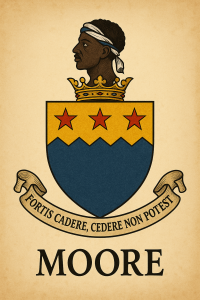
The Moore family coat of arms has endured for centuries as a symbol of courage and honor. Its earliest form is traced to the Moores of Kent in England, the same line from which Rev. John Moore of Newtown, Long Island, descended. When members of the family established themselves in Ireland during the sixteenth century, the arms were confirmed to the Moores of Mellifont and later granted to the Viscounts and Earls of Drogheda.
The official blazon, recorded in English and Irish heraldic rolls, reads:
Per fesse indented Or and Azure, three mullets in chief Gules.
Crest:
Out of a ducal coronet Or, a Moor’s head proper, wreathed Argent and Azure.
Motto:
Fortis cadere, cedere non potest (“The brave may fall but cannot yield”).
The shield is divided gold and blue by a deeply indented line, bearing three red stars in the upper field. Above it rises a Moor’s head from a golden coronet, wreathed in silver and blue. Though the image has prompted curiosity, it was not a reference to ancestry but a heraldic pun on the family name. Such symbolic “canting arms” were common in medieval Europe, where visual language expressed the bearer’s identity through art rather than words.
The motto reflects the spirit that marked the Moore family across generations. Its meaning, “the brave may fall but cannot yield,” captured a belief in endurance under trial. The phrase appeared on seals, tombs, and memorials in both England and Ireland and later found its way into the possessions of Moore descendants who crossed to America.
In time, variations of the same arms appeared among the family’s many branches. The noble house of Drogheda added supporters of two white greyhounds, while the colonial Moores of Long Island retained the indented gold-and-blue shield and its original motto. Together these emblems form a visual bridge between the English homeland, the Irish estates, and the American line that carried the name into a new world.